It’s not like a job interview where you are able to prepare yourself for the future. You will never expect it to happen to you, and when it does, you probably won’t be prepared or mentally stable for the coming days, months, and years. No one expects to be a victim of violent crime, but in the unfortunate circumstance that violent crime does happen, Volunteers in Victim Assistance (VIVA) will be here for you.
“They can’t function, they can’t work, they can’t do anything,” says VIVA Executive Director Carole McDonald of crime victims. “They can be at a grocery store with a cart full of groceries and it hits, he’s never coming back again. The reality of what happened hits and that’s when they really need help.”
Located at 2020 Hurley Way in Sacramento, VIVA has been in operation under McDonald’s care for 32 years.
Crisis intervention, counseling, individual, family and group therapy, and advocacy are a few of the main services that VIVA offers. Their goal is to offer advocacy and therapy to anyone who walks through their door.
“They [victims] come in right after the crime takes place,” McDonald says. “They’re very confused, in shock, in the midst of funeral costs, and they have post-traumatic stress disorder. It takes a while to sink in.”
It has been said that pain and suffering are natural elements of the universal human condition. Most of us will experience some degree of trauma in our lifetime, but our responses to that trauma will vary significantly based on a variety of factors including genetics, disposition, temperament, and early home life. Mental health professionals cannot pinpoint a single, universal reason that some victims display more resilience to the crippling effects of trauma; however, they do know that there is a strong link between violent crime and ensuing psychological distress. For this reason, mental health services can be a critical resource for victims.
On the heels of recent tragedies like the Isla Vista shooting and the Reynolds High attack in Troutdale, OR, it is certainly important to consider the factors that may cause criminal conduct and to address the role of our mental health system in violence prevention; yet, it is equally important to address the well-being of victims and to recognize the host of mental health challenges they face as a result of violent crime.
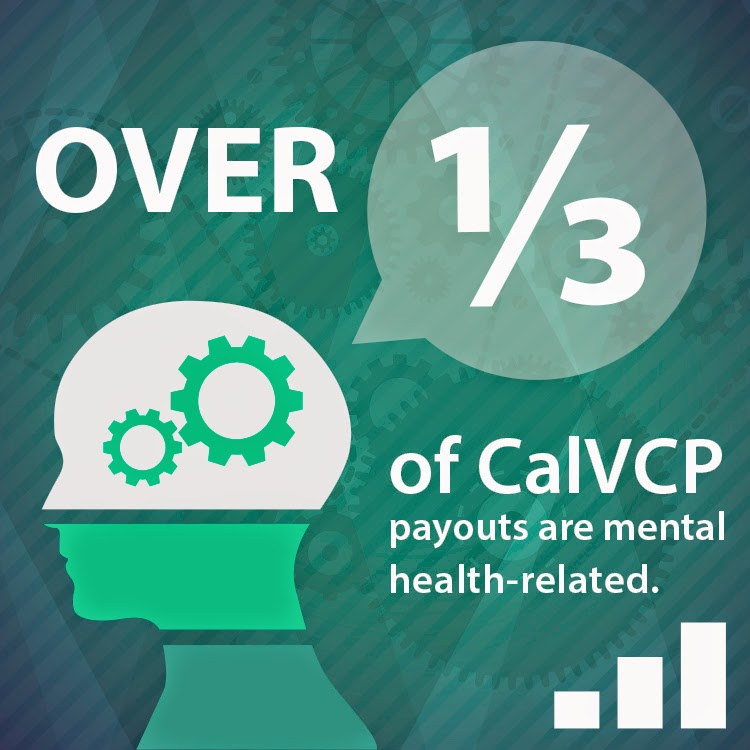
Over one-third of California Victim Compensation Program (CalVCP) payouts are mental health-related. Last year, the program provided over $21 million to crime victims for mental health expenses alone, proof that physical injury is far from the only major impact of violent crime.
CalVCP Staff Psychologist Dr. James Kent explains that violent crime leaves behind not just tangible scars, but also serves as a mental reminder that the world isn’t as orderly and safe as we’d like to believe. As victims attempt to cope with the aftermath of a violent crime, they may experience debilitating psychological and emotional effects that persist long after physical wounds have healed. According to Dr. Kent, symptom responses can include anxiety, depression, diminished self-esteem, self-fault, increased dependence, feelings of incompetence. Victimization can also result in shock, numbness, denial, hyper-vigilance, anger or irritability, detachment or estrangement of others, memory loss or forgetfulness, sleeping disorders, and recurring flashbacks or intrusive thoughts. Child victims have been known to suffer long-term mental health effects leading to poor academic performance, aggression, antisocial behavior, and substance abuse.
CalVCP is dedicated to assisting victims with expenses related to inpatient and outpatient mental health treatment that is necessary as a direct result of a qualifying violent crime. In addition, minors who suffer emotional injuries from witnessing a violent crime may be eligible for up to $5,000 in mental health counseling. This filing status can be especially valuable in instances such as school shootings, when a minor witness is not related to the victim but was in close proximity to the crime. By providing financial assistance and resources, CalVCP strives to promote healing and allow victims the opportunity to restore their lives to their fullest potential.
To learn more about the mental health benefits available through CalVCP, watch our Victim Services Talk Series (Ep. 4, "Mental Health Services for Victims") or visit our Victim Issues webpage.
Mental Health Services are a Vital Resource for Victims of Crime
By Robin Foemmel Bie, Licensed Clinical Social Worker and CalVCP Manager
While broken bones can be set and lacerations can be stitched up, other serious consequences of violent crime are often invisible. That is why the California Victim Compensation Program (CalVCP) seeks to actively address the mental health needs of crime victims.
CalVCP provided $23.5 million in assistance for the mental health treatment of victims of violent crime during fiscal year 2011-12, one-third of the total compensation provided by the program’s Restitution Fund. (Medical treatments, the fund’s only larger payment category, provided $25.2 million in assistance that year.)
"There is no one-size-fits-all approach for achieving successful mental health outcomes. Individual treatment plans tailored to each victim’s specific needs are most effective."
Eligible CalVCP claimants are able to choose any qualified mental health service provider for treatment. Crime victims are frequently connected with mental health services via victim advocates located at the Victim Witness Assistance Centers that exist across California. Additionally, county departments responsible for services such as child welfare also refer crime victims to mental health professionals, while other victims locate treatment providers through word-of-mouth.
Whatever the initial route of referral, there is no one-size-fits-all approach for achieving successful mental health outcomes. Individual treatment plans tailored to each victim’s specific needs are most effective.
Typically, treatment begins with an intake session, where the therapist documents the claimant’s personal, medical, and mental health history. During the next few sessions the therapist and claimant develop the treatment plan and goals based on the symptoms being experienced by the claimant. Sessions may be individual, family and/or group depending on the course of treatment agreed upon by the claimant and therapist. Treatment plans may be altered as therapy unfolds, and having the right fit between claimant and therapist is optimal.
In January 2013, the deadline for filing a claim with CalVCP was extended from one year after the occurrence of a violent crime to three years. The goal is to enable more victims to obtain assistance for their various post-crime needs. Compared to some physical injuries, mental health problems can manifest more slowly and last longer. The new filing deadline may be especially helpful for claimants suffering from a delayed emotional response to the crime.
CalVCP places high priority on mental health treatment, ensuring that this major — often less obvious — impact of violent crime is not forgotten.
Robin Foemmel Bie is a Licensed Clinical Social Worker and works as a manager for the California Victim Compensation Program (CalVCP). She has over 5 years of experience at CalVCP as the Provider Ombudsman and Manager, working with mental health and medical providers to serve victims. Prior to her work at CalVCP, Robin provided expertise on policy, networking, regulation and training for the Department of Mental Health. Robin has a Master’s Degree in Social Work with an emphasis in Health and Mental Health.
Bullying does not harm only the child being
bullied, but has long term detrimental effects for everyone involved. In one study, 60% percent of those
identified as a bully in grade school had at least one criminal conviction by
age 24; 35 – 40% of those adults had three or more convictions.
Back-to-school season is in full swing. Between the back-to-school shopping, end of summer vacations, and the dreaded task of getting children back in the habit of waking up early, it can be a very hectic and stressful time for parents. Added to this are concerns over school safety and violence making parents even more stressed. Some children shudder at the thought of going back to school because before long they will be returning to an abusive situation of bullying.
As many as 77% of all children have encountered some type of bullying, whether it be verbal, mental, or physical abuse, according to BullyStatistics.org. Bullying does not harm only the child being bullied, but has long term detrimental effects for everyone involved. Children who are bullied have a greater risk of depression, low self-esteem, are more likely to run away, and have a higher risk of abusing alcohol or drugs in their lifetime. Many parents are unaware that bullying can be just as destructive for the bully. In one study, 60% percent of those identified as a bully in grade school had at least one criminal conviction by age 24; 35 – 40% of those adults had three or more convictions.
As many as 77% of all children have encountered some type of bullying, whether it be verbal, mental, or physical abuse, according to BullyStatistics.org.
Lawmakers are aware of this escalating problem and are working attentively to reduce these numbers. New laws recently passed will assist schools and faculty in clearly defining bullying and setting up a procedure to address the issue.
CalVCP is dedicated to helping victims of school violence and bullying. For cases that qualify, CalVCP provides financial assistance for children that are victims of such situations. In cases where a child experiences mental distress from witnessing a crime, CalVCP will assist eligible students with counseling expenses.
Prevention is also an important aspect in dealing with bullying. The following tips can help parents prevent the abuse that stems from bullying:
Know the signs – Unexplained bruises or cuts, fear of returning to school, a drop in grades, or depression can all be signs of bullying. Behavioral issues like getting in trouble at school or obsession with popularity may be signs that your kid is a bully.
Open Communication – Often, kids will not want to share if they are having problems at school, but by simply asking your child how their day was or what they like most about their friends may give you some insight to their lives. If you do suspect a problem, explain to them that there’s no shame in being bullied and that it’s not their fault. Openly talking about it is the first step to fixing the problem.
Learn conflict management- The key word is management; not all conflict in life is resolvable, but most times it is manageable. Teaching your children to know the difference and how to handle different types of conflict is a skill they can use for life.
Adopt healthy hobbies - Encouraging your child to get involved in healthy hobbies in and out of school can be a great outlet for them to socialize, build new skill sets and healthy relationships. Having a hobby that assists your child in making friends and build confidence will be a positive influence that will assist them in dealing with any potential bullying.
Pay attention to friends – Paying close attention to the company your child keeps can be a great indicator of the type of influences your child has. If you believe certain friends are a bad influence, it’s important that you address this promptly and redirect their attention to spending time with a more positive influence.
The task of raising a child to be a healthy, respectful, productive adult is a full-time job and can at times be overwhelming. By incorporating these tips, providing a loving home, and taking a genuine interest in your child’s life, you will undoubtedly get them headed in the right direction
Last week, members of the Victim Compensation and Government Claims Board made some very difficult decisions regarding the services CalVCP provides. These decisions, while not easy, were necessary in the face of a diminishing Restitution Fund. For the past few years the amount of revenue received from restitution fines, orders and penalties has declined. For FY 2010-11 the Governor’s budget estimates our revenues will be down by 3%, while claim payments are projected to increase by 2.1%. At this pace without budget reductions, the Restitution Fund will be $4.2 million in the red by June 2012 and have a $36.2 million negative balance by June 2013.
In an effort to assure that the Board can continue to compensate victims of crime, the Governor’s Budget for FY 2011-12 calls for more than $5.8 million in savings which includes a $2.2 million savings in operating expenses and a reduction in Joint Power (JP) and Criminal Restitution Compact (CRC) local assistance program contracts of $700,000. It also places a cap on the growth rate of benefit payments to victims of 2.5 percent for claims from FY 2010-11 to FY 2011-12. However, even with these proposed savings in the Governor’s budget, the Restitution Fund would still have a deficit of $20.3 million in 2013.
That is why the Board took decisive actions and voted on measures that will provide a savings of $15.7 million and better align the program benefit payments with its revenues. Specifically, the Board voted to:
Limit chiropractic, physical and occupational therapy to a combined total of five sessions and require a physician’s recommendation for additional sessions up to a maximum of 20 sessions.
Limit income and support loss benefits to victims who are actually employed at the time of the crime and require income and tax records to verify income.
Establish a maximum benefit of $30,000 for vehicle purchase, renovation and retrofitting per qualifying crime.
Determine appropriateness of attorney fee limit of payment in statute and prepare a regulation that requires verification of the reasonable value of legal services provided to an applicant.
Establish a maximum benefit for funeral and burial expenses of $5,000 and remove food and beverages as reimbursable expenses.
Establish a maximum benefit amount of $63,000.
Reduce the CalVCP medical reimbursement rate to the flat Medicare rate and reduce restorative cosmetic surgery, prosthetics, hearing aids and eyeglasses, and foreign provider rates by 20%.
Reduce the CalVCP mental health reimbursement rate by 10%.
Continue the reduction of the reimbursement rate for mental health services provided by interns adopted by the Board on December 16, 2010 and implemented by staff in January 2011.
These actions adopted by the Board along with the other cost savings measures that the Board has already implemented such as reducing our administrative costs, holding positions vacant, limiting outreach and training and travel expenditures, will allow CalVCP to realize a balance of approximately $14 million by 2013. We will continue to work with our stakeholders on finding more long-term solutions to ensure solvency of the Restitution Fund for years to come so that we may continue to provide vital services to victims of violent crime in California.