Showing posts with label Crime Victims. Show all posts

Monday, January 11, 2016

Looking Ahead: Human Trafficking Awareness Month

By Julie Nauman, VCGCB Executive Officer

Greetings, and a very Happy New Year to you.

As we enter a new year together, it is a good time to reflect on our accomplishments from the past 12 months, but to also take inventory, and to take action on the work that lies ahead.

Such is the case with the subject of Human Trafficking. The month of January is set aside to increase awareness of this important topic, and to increase access to the services we provide to trafficking survivors. Today we acknowledge and honor Human Trafficking Awareness Day, which is a part of a month-long commemoration set aside to increase awareness of this important topic and to increase access to the services we provide to trafficking survivors.

More than 20 million men, women and children around the world and in our own communities are currently victims of human trafficking — a $32 billion dollar industry that transcends age, gender, race and status. 

We have come a long way in how we now handle these cases. For years, state law did not allow these victims to receive benefits if they had participated in a crime or were involved in the events leading to their victimization. 

They were treated as prostitutes and disqualified, whether or not they had been forced into sexual slavery, and subjected to rape and physical and mental abuse. Many of them did what they had to do, simply to survive. We saw the need for change, and added a regulation in 2014 to allow them to get assistance from our California Victims Compensation Program (CalVCP).  

Since that time, we have received many applications from human trafficking victims — a population we had not served before. But we want to help all of these victims, so we need to collaborate with our partners to reach out to these individuals who desperately need our help.

trauma-informed training

In light of this, we are hosting a human trafficking trauma-informed training to educate our staff and our partners who work with these human trafficking victims. This training will be presented by Chris Stambaugh from The Grace Network, a grassroots organization that has mobilized thousands of people to combat human trafficking. Chris will discuss how they use technology to reach and serve victims, and will give a presentation on their free user-friendly resource app, “GraceCity” that allows first responders to access services for those affected by human trafficking. This training will be live-streamed on January 14, 2016 at 10 a.m. This focused training will be extremely informative and helpful as we continue to explore better ways to meet the unique needs of these survivors.

The training builds upon our earlier human trafficking workshop presented by Opening Doors, which is available to view anytime. This workshop gives insight into how you can identify a victim of sex trafficking, forced labor and debt bondage and the psychological mechanisms behind the abuse.  

Additionally, we have developed a short public service announcement (PSA) featuring our Board member, and San Bernardino County District Attorney, Michael Ramos. District Attorney Ramos has been a leader in California in recognizing that women, men, and children who are trafficked are victims of crime and their trafficking must be aggressively prosecuted. We ask that you share this PSA with your own networks.

As we go forward, CalVCP will continue to engage in the discussion of human trafficking and how this critical subject is handled through law enforcement and the victim services arena.

I am honored to work in a state dedicated to education and action, striving to make a tangible difference in the lives of victims. We invite you to participate in our workshops during Human Trafficking Awareness Month and we encourage you to join us in this effort to ensure that all victims of human trafficking receive the respectful and compassionate help they deserve.


Julie Nauman is the Executive Officer for the Victim Compensation and Government Claims Board (VCGCB). VCGCB provides compensation for victims of violent crime and helps to resolve claims against the State.

Friday, May 1, 2015

The San Diego Family Justice Center: Providing Help and Hope to Victims of Family Violence

By the San Diego Family Justice Center

What do cancer and domestic violence have in common? Both are things you don’t want, erode your quality of life and are challenging issues without a single cure-all.

Fortunately, there’s good news. Just as modern cancer centers are staffed with highly trained oncologists and support specialists, a Family Justice Center attacks domestic violence in the same way; by treating the cause, not the symptoms — all in one location.

Founded in 2002, the San Diego Family Justice Center, located at 1122 Broadway, Suite 200 in downtown San Diego, is the first center in the world to co-locate all DV-related services under one roof. With the need to travel to multiple locations eliminated, this model significantly reduces the possibility of someone receiving conflicting advice from different service professionals.

Monday, March 23, 2015

Why Family Justice Centers?

By Cherri N. Allison, Esq.

Imagine that you are a domestic violence victim and the mother of two small children under the age of ten. You have been in a physically and emotionally abusive relationship for 12 years. You are a stay at home mom and your husband controls all of the family finances. You have just found out you are pregnant and are afraid to tell your spouse because the last time you did the violence escalated. You literally have nowhere to turn. The police have been to your home several times and you have been in the hospital emergency room more than once. Before the Alameda County Family Justice Center opened in 2005 you literally had to navigate dozens of agencies in a county that spans 821 square miles. You must maneuver a medical system; navigate criminal and civil legal systems, and a court system that is incomprehensible at best. At the same time you are experiencing extreme emotional and financial stress and the possibility of homelessness. There must be a better way!

Simply locating different organizations in one space is not necessarily innovative nor does it inspire systems change or movement building. However, when the people who lead those organizations and maintain those systems begin to reach across barriers, real or imagined, such as the language of disciplines, stereotypes and implicit bias, client service delivery changes. Letting go of the need to be right, demystifying program and systems content are at the core of the Family Justice Center model. We must make thinking outside the boundaries the norm and operate from a client centered, strength based perspective to implement systems change work that has positive implications for clients.

Tuesday, July 8, 2014

Beyond the Physical Damage of Violent Crime

By Julie Nauman, VCGCB Executive Officer

It has been said that pain and suffering are natural elements of the universal human condition. Most of us will experience some degree of trauma in our lifetime, but our responses to that trauma will vary significantly based on a variety of factors including genetics, disposition, temperament, and early home life. Mental health professionals cannot pinpoint a single, universal reason that some victims display more resilience to the crippling effects of trauma; however, they do know that there is a strong link between violent crime and ensuing psychological distress. For this reason, mental health services can be a critical resource for victims.

On the heels of recent tragedies like the Isla Vista shooting and the Reynolds High attack in Troutdale, OR, it is certainly important to consider the factors that may cause criminal conduct and to address the role of our mental health system in violence prevention; yet, it is equally important to address the well-being of victims and to recognize the host of mental health challenges they face as a result of violent crime.

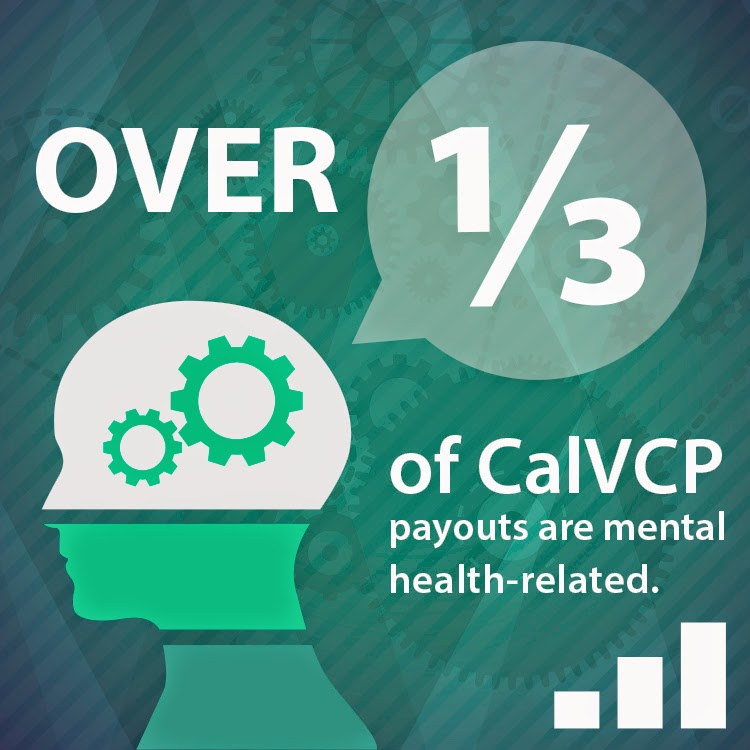
Over one-third of California Victim Compensation Program (CalVCP) payouts are mental health-related. Last year, the program provided over $21 million to crime victims for mental health expenses alone, proof that physical injury is far from the only major impact of violent crime.

CalVCP Staff Psychologist Dr. James Kent explains that violent crime leaves behind not just tangible scars, but also serves as a mental reminder that the world isn’t as orderly and safe as we’d like to believe. As victims attempt to cope with the aftermath of a violent crime, they may experience debilitating psychological and emotional effects that persist long after physical wounds have healed. According to Dr. Kent, symptom responses can include anxiety, depression, diminished self-esteem, self-fault, increased dependence, feelings of incompetence. Victimization can also result in shock, numbness, denial, hyper-vigilance, anger or irritability, detachment or estrangement of others, memory loss or forgetfulness, sleeping disorders, and recurring flashbacks or intrusive thoughts. Child victims have been known to suffer long-term mental health effects leading to poor academic performance, aggression, antisocial behavior, and substance abuse.

CalVCP is dedicated to assisting victims with expenses related to inpatient and outpatient mental health treatment that is necessary as a direct result of a qualifying violent crime. In addition, minors who suffer emotional injuries from witnessing a violent crime may be eligible for up to $5,000 in mental health counseling. This filing status can be especially valuable in instances such as school shootings, when a minor witness is not related to the victim but was in close proximity to the crime. By providing financial assistance and resources, CalVCP strives to promote healing and allow victims the opportunity to restore their lives to their fullest potential.


To learn more about the mental health benefits available through CalVCP, watch our Victim Services Talk Series (Ep. 4, "Mental Health Services for Victims") or visit our Victim Issues webpage.


Julie Nauman is the Executive Officer for the Victim Compensation and Government Claims Board (VCGCB). VCGCB provides compensation for victims of violent crime and helps to resolve claims against the State.

Thursday, April 24, 2014

Innovation in Victims’ Services: Courthouse Dogs

In many ways, Aloha is just like any other playful pup. She loves to roll in the grass, chase her handler’s young daughters, and chew on her favorite red toy. But Aloha is not your average dog. She is a courthouse dog; an extraordinary canine who provides paws-itive support to victims of violent crime. The one and a half-year-old Australian multigenerational labradoodle, with her captivating green eyes and a bright pink nose, is one of two companion dogs that serve the Yolo County District Attorney’s office.
From right: Yolo County District Attorney Jeff Reisig, Government Operations Agency Secretary Marybel Batjer, and County Victim Services Program Manager Laura Valdes, with Aloha

District Attorney Jeff Reisig introduced the working dog program to Yolo County in 2008. The concept developed out of the notion that dogs — as man’s best friends — might provide a comforting and reassuring presence to crime survivors during victim/witness interviews and courtroom interrogations.

Aloha was bred and trained at Gabby Jack Ranch, a nonprofit organization out of Penn Valley, California that provides service, therapy and comfort dogs for people with physical and/or emotional challenges. She began her service training when she was just ten weeks old with Training Coordinator Terry Sandhoff, and is now part of an elite team formally known as High Performance Therapy (HPT) Dogs focused specifically on aiding the victim services community. In order to most effectively support survivors, who often suffer enduring psychological disabilities such as Post Traumatic Stress Disorder (PTSD), Aloha has undergone extensive, specialized training focused on the needs of victim services.
“Therapy dogs help people victimized by others to open up, tell someone and turn their traumatic events into personal triumph.”
—Gabby Jack Ranch founder and CEO Jacque Reynolds

Canine companions like Aloha are trained to assist crime victims and witnesses as they prepare for court and while testifying in trials, as well as to build courage and confidence in their ability to open up about the crimes they have been too afraid or too ashamed to face. In addition, the temperament, intelligence and friendly dispositions of HPT dogs make them very successful in comforting both adults and children alike. For kids, pups like Aloha serve as “a friend to whom they can share all of the horrors, tell all of their fears and receive non-judgmental and unconditional acceptance,” shares Gabby Jack Ranch founder and CEO Jacque Reynolds.

Tuesday, April 1, 2014

Crime Victims' Rights Month: The Attention Belongs to Victims

According to the California Attorney General’s Office, over 440 violent crimes are reported in California each day. During April, CalVCP observes California Crime Victims’ Rights Month (CVRM) to honor, recognize, support, and advocate for survivors of violence.

In a time when much attention is placed on the criminal offenders, and even offender rights, it is imperative that we bring focus back to the victims who need it. This year’s CVRM theme, “Victims’ Rights, Victims’ First,” underscores the need to make victims’ rights a top priority.


Violent crime does not discriminate; it can affect anybody, in any community. During CVRM, our hope is not only to raise awareness, but to inspire action. We encourage everyone to take the time to learn about your rights and the services available to you and your loved ones.

CalVCP will honor victims and thank those who assist them throughout a number of activities during Crime Victims’ Rights Month. We encourage you to join and participate:

  • County Observances — CalVCP will join county officials across the state to honor both victims and the advocates who help guide survivors through the justice process and direct them to critical resources.
  • Podcasts — CalVCP will release a series of short interviews with courageous survivors who will share their experiences and describe their healing process.
  • Victims’ Rights Digital Town Hall — CalVCP will host an online town hall discussion addressing a variety of topics, including how to reach the underserved through collaborative efforts.
  • CVRM April 2014 Public Service Announcement — This video features California Attorney General Kamala D. Harris speaking to survivors, advocates, and community leaders on the important work being done to prevent crime, provide services to victims, and honor the lives of those lost to violent crimes.
  • Blogs — CalVCP will post a number of guest blogs examining issues, personal stories, and helpful tools and services, written by respected leaders in the victims’ rights community.
  • Denim Day — On Wednesday, April 23rd, CalVCP and millions across the nation will wear denim as a symbol of protest against erroneous and destructive attitudes about sexual assault.

For more information, visit CalVCP's California Crime Victims’ Rights Month website.


California Victim Compensation Program Logo
The California Victim Compensation Program (CalVCP) provides compensation for victims of violent crime. CalVCP provides eligible victims with reimbursement for many crime-related expenses. CalVCP funding comes from restitution paid by criminal offenders through fines, orders, penalty assessments and federal matching funds.

Monday, January 27, 2014

National Stalking Awareness Month

By Julie Nauman, VCGCB Executive Officer

This January, CalVCP joins the nation in observing the 10th anniversary of National Stalking Awareness Month. In standing with President Obama’s Proclamation, we dedicate this month to “pursuing justice for victims of stalking and ensuring survivors receive the support they need.”

According to California law, stalking is defined as willfully, maliciously, and repeatedly following or harassing another person. It’s not necessarily a single criminal act, but a series of actions directed at a person that causes the victim to fear for his or her safety.

Stalking can include:
  • Unwanted phone calls, texts, letters, emails, or gifts 
  • Following or spying
  • Tracking actions, location, or private information using technology
  • Spreading rumors
  • Waiting at places for victim; showing up at locations without a legitimate reason
  • Harassing victim’s friends or family
We must teach our youth that stalking is not a joke. It’s not romantic. Far too often, threats can escalate into physical assault or even homicide. It is time to dispel the many common myths that allow stalking behaviors to persist.

It’s worth noting that the word “stalking” has undergone a bizarre evolution in today’s popular culture, with modern technologies blurring the line between destructive crime and casual pastime. Trendy teenagers and young adults can often be heard joking about “Facebook stalking” their best friends or potential partners, a reference to the tracking of a person’s social media page for pictures, status updates, and other personal information. This seemingly innocuous term is in fact very dangerous, as it essentially decriminalizes stalking and minimizes the severity of a very illegal offense. Coincidentally, persons ages 18 to 24 experience the highest rate of stalking victimization. We must teach our youth that stalking is not a joke. It’s not romantic. Far too often, threats can escalate into physical assault or even homicide.It is time to dispel the many common myths that allow stalking behaviors to persist.

The following are examples of widely held misconceptions surrounding stalking:
Stalking is more than just an annoyance or unwanted attention. It’s an abusive behavior and a serious crime. By recognizing this fact and helping to change attitudes, we can better provide support and healing to victims as well as hold their stalkers accountable.

If you or someone you know is being victimized by a stalker, there are a variety of resources available to help:

Join me this January for National Stalking Awareness Month as we stand behind victims, survivors, law enforcement, first responders, advocates, and service providers in the collaborative effort to create a safer nation for all. 


Julie Nauman is the Executive Officer for the Victim Compensation and Government Claims Board (VCGCB). VCGCB provides compensation for victims of violent crime and helps to resolve claims against the State.

Tuesday, September 24, 2013

Protecting Victims’ Rights: Victims Information Notification Everyday (VINE)

By Sheriff Greg Ahern (Alameda County), President of the California State Sheriff’s Association

As our communities become more entrenched with technology, many law enforcement partners are taking on a greater role to create safer communities. The California State Sheriffs’ Association (CSSA) is assisting victims of domestic violence and other serious violent crimes through the Victims Information Notification Everyday (VINE).

The VINE Program is a 24-hour service that provides instant notification to individuals concerning the whereabouts of the person(s) who victimized them. Administered by the California Department of Corrections and Rehabilitation (CDCR) in partnership with the CSSA, the VINE database tracks an offender’s information from the point of apprehension to re-entry into society, and it details transfers and relocations while he/she is incarcerated. This system allows victims to take the necessary steps and precautions for self-protection. Victims, witnesses, and next of kin can sign up to receive notifications, and all registrants’ information is confidential.

VINE has been partnered with the Alameda County community since 1996. During this time span, the system has delivered over 230,000 notification telephone calls to victims in the county. In addition, VINE was one of the first systems to utilize email technology, allowing registrants to receive notifications while away from home. To date, the Alameda County VINE Program has notified almost 4,000 individuals via email. VINE has also recently expanded its ability to contact users through social media efforts: a new iPhone and Android smart phone application informs victims of changes in the custody status of criminal offenders. This application is free to crime victims and is anonymous for users.

Although VINE caters primarily to victims of domestic violence, it also serves as an informational resource for both the public and private sectors. For example, VINE is used by employers to track the release date of disgruntled employees; journalists utilize the system to find the release date of high-profile offenders; judges refer to VINE to learn the release date of offenders who they have sentenced; and law enforcement consults this service to stay informed on the status of offenders in their own case files.

As the nation’s first automated system for victim notification, VINE seeks to preserve a victim’s right to personal safety following a crime. Just this year, there have been 961 new VINE registrants in Alameda County, and over 11,000 VINE notifications have been sent. The program’s success is even more impressive when reviewing statewide statistics. VINE is now live in 53 California counties, and there have been over one million offender searches performed throughout the state in 2013. The program has proven to be an effective tool that enables survivors to take pre-emptive action to avoid being victimized again. I urge law enforcement agencies that utilize the VINE Program to publicize their success, and others that are not members to join this valuable program.

For more information, see the California VINE website.


Gregory Ahern has served as the Sheriff of Alameda County since 2007 and is the current President of the California State Sheriff’s Association. Employed by the Alameda County Sheriff’s Office for over 30 years, Sheriff Ahern has been actively involved in the development and implementation of a number of Alameda County programs, including the Youth and Family Services Bureau, Drug Education and Enforcement programs, Cold Case DNA Unit, and D.U.I. Enforcement Unit. He also initiated the Urban Shield tactical training exercise that provides a training venue to several thousand first responders each year. Sheriff Ahern earned a Bachelor’s Degree in Economics and Business Administration from Saint Mary’s College in Moraga.

Friday, August 2, 2013

30th Annual National Night Out

2013 marks the 30th anniversary of National Night Out (NNO), a major campaign aimed at crime prevention through community building at the local levels. In conjunction with this observance, 2013 is also the first year NNO has been officially recognized by the State of California. On July 9th, the State Senate unanimously approved a resolution by Senator Norma Torres (D-Pomona) establishing August 6, 2013 as National Night Out in the Golden State.

From 6:00 p.m. to 10:00 p.m. on August 6th, residents in California and across the nation are invited to lock their doors, turn on outside lights, and step outside to enjoy the evening with neighbors while taking a united stand against crime. Cities and towns throughout the country will celebrate the occasion by hosting a variety of social events such as block parties, BBQ cookouts, ice cream socials, parades, and youth activities, all of which are attended by fellow residents and law enforcement.

The NNO campaign is designed to:
  • Heighten crime and drug prevention awareness;
  • Generate support for, and participation in, local anticrime programs;
  • Strengthen neighborhood spirit and police-community partnerships; and
  • Send a message to criminals letting them know that neighborhoods are organized and fighting back.

CalVCP knows the immense toll that crime takes on victims and their loved ones. Over 150,000 violent crimes are reported in California each year, and many more are believed to go unreported due to fear or embarrassment. In the 2011-2012 fiscal year alone, CalVCP received over 53,000 applications for victim assistance. Given these startling statistics, the widespread reach of NNO renders it an invaluable vehicle for constructive dialogue and positive change. As a leading advocate in the fight against crime, CalVCP recognizes that a safer nation starts at the individual and community levels. A city is only as strong as the citizens that reside within it, and NNO represents a key step in making neighborhoods a safer place year round.

NNO was founded in 1984 as an effort by the National Association of Town Watch (NATW) to promote civic engagement and involvement in crime prevention activities, police-community partnerships, and neighborhood camaraderie. That year, 2.5 million Americans took part across 400 communities in 23 states. By 2012, NNO participation had expanded to 15,704 communities to unite 37.5 million people from all 50 states, U.S. territories, Canadian cities, and military bases worldwide. NNO 2013 is expected to be the largest ever.

This August, let’s join forces with our neighbors nationwide to build community relationships and neighborhood unity and give crime the ultimate going away party.

Any municipality, law enforcement agency, crime prevention organization, community group, or neighborhood interested in participating in NNO 2013 is invited to register here.

Monday, July 8, 2013

Restitution Rights for Victims

By Julie Nauman, VCGCB Executive Officer

The question was recently posed about the fairness of asking defendants to pay restitution when they have so many other hurdles to overcome. I certainly understand these are trying financial times for everyone, for defendants and victims. While difficulties for offenders post-incarceration may be more visible to the public, let me remind you that we receive requests for assistance from victims that have lost jobs, homes, means of transportation, and physical aptitude, many of whom have suffered life-altering changes and significant mental trauma as a result of crime. Victims do not ask to be victimized and each has the absolute right to be made whole.

Many crime victims suffer life-altering losses.

The Victims’ Bill of Rights Act of 2008 codified the right to restitution along with other important victim rights. Restitution plays an important role in healing for victims. It is designed to provide financial restoration and to mitigate some of the negative impacts of crime. A victim of crime should not have to suffer calls from bill collectors or loss of independence because of someone else’s choices. Restitution can financially relieve the burdens placed on victims as a result of the crimes that occurred.

Restitution can be beneficial not only for victims, but also for offenders. For many offenders, restitution acts as a tool for their rehabilitation. Studies have shown that paying restitution can reduce recidivism. It gives offenders a way to take responsibility for their actions, make reparations to victims, and address feelings of guilt in a helpful way.
"We cannot forget about the support needed for victims who are impacted by unforeseen crimes, many of whose worlds are turned upside down."

There is no mistaking that crime costs us all. However, restitution fines help to shift the financial responsibility for crime back to the offenders. The money collected through fines paid by offenders helps to keep the Restitution Fund viable so victims’ needs may be met if there is no other form of payment available; for example, when the offender’s identity is unknown, or when a defendant is unable to pay for all of the expenses immediately.

It is important to uphold the rights of California’s victims. We cannot forget about the support needed for victims who are impacted by unforeseen crimes, many of whose worlds are turned upside down. I remain committed to our fight to ensure that victims receive the restitution owed to them and that offenders pay their debts.


Julie Nauman is the Executive Officer for the Victim Compensation and Government Claims Board (VCGCB). VCGCB provides compensation for victims of violent crime and helps to resolve claims against the State.

Tuesday, June 4, 2013

Avenues for Healing

Mental Health Services are a Vital Resource for Victims of Crime


By Robin Foemmel Bie, Licensed Clinical Social Worker and CalVCP Manager

While broken bones can be set and lacerations can be stitched up, other serious consequences of violent crime are often invisible. That is why the California Victim Compensation Program (CalVCP) seeks to actively address the mental health needs of crime victims.

CalVCP provided $23.5 million in assistance for the mental health treatment of victims of violent crime during fiscal year 2011-12, one-third of the total compensation provided by the program’s Restitution Fund. (Medical treatments, the fund’s only larger payment category, provided $25.2 million in assistance that year.)
"There is no one-size-fits-all approach for achieving successful mental health outcomes. Individual treatment plans tailored to each victim’s specific needs are most effective."


Eligible CalVCP claimants are able to choose any qualified mental health service provider for treatment. Crime victims are frequently connected with mental health services via victim advocates located at the Victim Witness Assistance Centers that exist across California. Additionally, county departments responsible for services such as child welfare also refer crime victims to mental health professionals, while other victims locate treatment providers through word-of-mouth.

Whatever the initial route of referral, there is no one-size-fits-all approach for achieving successful mental health outcomes. Individual treatment plans tailored to each victim’s specific needs are most effective.

Typically, treatment begins with an intake session, where the therapist documents the claimant’s personal, medical, and mental health history. During the next few sessions the therapist and claimant develop the treatment plan and goals based on the symptoms being experienced by the claimant. Sessions may be individual, family and/or group depending on the course of treatment agreed upon by the claimant and therapist. Treatment plans may be altered as therapy unfolds, and having the right fit between claimant and therapist is optimal.

In January 2013, the deadline for filing a claim with CalVCP was extended from one year after the occurrence of a violent crime to three years. The goal is to enable more victims to obtain assistance for their various post-crime needs. Compared to some physical injuries, mental health problems can manifest more slowly and last longer. The new filing deadline may be especially helpful for claimants suffering from a delayed emotional response to the crime.

CalVCP places high priority on mental health treatment, ensuring that this major — often less obvious — impact of violent crime is not forgotten.


Robin Foemmel Bie is a Licensed Clinical Social Worker and works as a manager for the California Victim Compensation Program (CalVCP). She has over 5 years of experience at CalVCP as the Provider Ombudsman and Manager, working with mental health and medical providers to serve victims. Prior to her work at CalVCP, Robin provided expertise on policy, networking, regulation and training for the Department of Mental Health. Robin has a Master’s Degree in Social Work with an emphasis in Health and Mental Health.

Monday, May 6, 2013

Official Observance Ends, Services Continue

By Julie Nauman, VCGCB Executive Officer

As the state with the first and largest victim compensation program and national leader of victims’ rights and services, California once again honored victims, provided resources, and united communities in its commemoration of Crime Victims’ Rights Month.

Around the state, advocates and government agencies held events and distributed information and services available to victims of crime. I am proud of all our statewide partners, as well as our staff here at CalVCP on the incredible job they have done in bringing attention to this very important issue.

Here are just a few examples of the outstanding statewide efforts last month:
CalVCP Executive Officer Julie Nauman greets California Attorney General Kamala D. Harris at the Victims' Rights Rally

I believe this year’s message, Facing New Challenges, Finding New Hope, was heard throughout California, and I’d like to share a few highlights with you. During the week of April 7, CalVCP Connection posted a series of guest blogs from crime victim experts and service providers (scroll down to read more). Later in the month we hosted our annual Victims’ Rights Rally and March in Sacramento with keynote speaker California Attorney General Kamala D. Harris. Lastly, we wrapped up the month with our first ever Victims’ Rights Digital Town Hall where Sacramento County District Attorney Jan Scully and El Dorado County District Attorney Vern Pierson moderated discussions on human trafficking, sexual assault, domestic violence, and victim resources.


Julie Nauman is the Executive Officer for the Victim Compensation and Government Claims Board (VCGCB). VCGCB provides compensation for victims of violent crime and helps to resolve claims against the State.

Monday, April 15, 2013

Restitution: A Fundamental Right for Victims

By National Crime Victim Law Institute

Victims of crime often suffer immeasurable harm as a result of the criminal conduct inflicted on them. The economic impact of such harm is rightly borne by the perpetrator, not the victim. Restitution is one mechanism by which the justice system can ensure that the perpetrator, not the victim, bears the burden. Restitution is ordered in criminal sentences and is money paid from the offender to the victim for losses that the victim suffered as a result of the offender’s crime. Ordering and securing collection of restitution is an important part of ensuring that victims are treated fairly and with dignity. Fortunately, every jurisdiction has a statutory provision providing a right to restitution, and at least eighteen states have enshrined the right in their constitutions. (Read more in NCVLI’s publication, A Summary of 12 Common Victims’ Rights). These restitution provisions have evolved out of a historical framework embodying both compensatory and penological (e.g., deterrence, rehabilitation, and accountability) aims.
Victims are fighting every day to secure full restitution orders.

Despite these laws affording victims statutory and constitutional rights to restitution, victims are fighting every day to secure full restitution orders and to recover even pennies on the dollar of those orders. NCVLI is a part of this fight. We are working to ensure that the right to restitution is meaningful so that victims are not asked to finance their own victimization.

As part of this fight we are working on four restitution cases pending in appellate courts right now! One of these is in front of the Oregon Supreme Court in a case in which defendant pled guilty to DUII and Assault IV and everyone in the case agreed on the economic losses of the victims. Despite this the trial court awarded the victims only 10% of their losses because the trial court thought the victims were “at fault” also. This insertion of what is known in civil law as “comparative fault” is a dangerous turn that could result in victims being put on trial and increased victim-blaming. NCVLI secured pro bono counsel for these victims and has submitted an amicus brief in the case!

In another case we are fighting in the Utah Supreme Court in a case in which defendant - convicted of unlawful sexual conduct with a minor not involving intercourse - has objected to the victims recovering the costs of travel and lost wages related to their attendance at court proceedings. NCVLI is submitting an amicus brief on the law. In this and all of our restitution cases we pose the question - how can we ask victims to report crimes and participate in our justice system if we turn around and hand them a bill?

We passed laws nationwide to ensure that victims of crime do not have to finance their own victimization. We must now fight to ensure that those rights are meaningful!


The National Crime Victim Law Institute (NCVLI) is a nonprofit educational and advocacy organization located at Lewis and Clark Law School in Portland, Oregon. NCVLI’s mission is to actively promote balance and fairness in the justice system through crime victim-centered legal advocacy, education, and resource sharing. NCVLI achieves its mission through education and training; promoting the National Alliance of Victims’ Rights Attorneys; researching and analyzing developments in crime victim law; and participating as amicus curiae in court cases nationwide, and assisting crime victim attorneys, advocates, and victims by providing information on crime victim law. NCVLI’s website contains a library on victim law.

Reprinted and/or reproduced with permission of the National Crime Victim Law Institute (NCVLI), all rights reserved. NCVLI actively promotes balance and fairness in the justice system through crime victim centered legal advocacy, education, and resource sharing. To view NCVLI’s library of crime victims’ rights publications, please visit www.ncvli.org.

Wednesday, April 10, 2013

Secretary of State — Safe at Home Program

By Debra Bowen, California Secretary of State

Crimes of domestic violence, stalking, and sexual assault affect millions of Americans each year. As California’s Secretary of State, I am proud to administer the Safe at Home address confidentiality program that offers anonymity to victims of these crimes.

Safe at Home participants use a free P.O. Box in Sacramento—instead of their home address—to help them maintain their privacy when receiving first-class mail, opening a bank account, filling out government documents, registering to vote, getting a California driver’s license, and much more. Since 1999, Safe at Home has helped to protect more than 6,000 survivors of domestic violence, stalking and sexual assault, as well as reproductive health care workers.
Safe at Home Program
P.O. Box 846
Sacramento, CA 95812

Telephone:
(877) 322-5227

TTY/TDD:
(916) 651-1304

safeathome@sos.ca.gov

To enroll in the Safe at Home program, applicants need to contact one of many enrolling agencies that can be found on the Safe at Home website. The enrolling agencies are trained to help people apply for the program and answer any questions they may have.

Once enrolled into Safe at Home, participants receive an identification card and a letter confirming their enrollment that helps to explain the Safe at Home program to California business entities. California state and county government agencies must accept the Safe at Home post office box as the participant’s mailing address.

Participating in the Safe at Home program gives victims an additional tool in their overall safety plan.


California Secretary of State Debra Bowen administers Safe at Home, the national model for confidential address programs, and authored some of the Safe at Home laws while previously serving as a state legislator. She served six years in the State Assembly and eight years in the State Senate, before being elected Secretary of State in 2006. She was reelected to her second term as Secretary of State in 2010. Secretary Bowen is a leader in open government reform, election integrity, and personal privacy rights.

Monday, March 25, 2013

Improving Access to Victim Services

By Senator Roderick D. Wright (D-South Los Angeles)

Last year I was proud to author Senate Bill 1299, a measure designed to simplify the administration of crime victim compensation program in California. Our hope was to help create an efficient system to ensure that those who have already been victims in their lives are not revictimized by the state, being made to jump through hoops to get the counseling and compensation they need and rightfully deserve.

The bill sailed out of both houses without a single "no" vote.
I am happy to say this was a cause the often-divided Legislature was able to rally around in a bipartisan fashion, as the bill sailed out of both houses without a single “no” vote.

Developed in cooperation with victim support groups and the Victim Compensation and Government Claims Board, SB 1299 makes several important changes in the administration of compensation for crime victims.

First, it clarifies the law to specifically allow for a social worker to file on behalf of a victim of child abuse or elder abuse who is unable to file on his or her own. It also allows for-profit providers to provide mental health services to victims and adds mental health care to the list of services for which the Board will reimburse costs within 90 days of a claim.

SB 1299 increased the CalVCP application filing period threefold.
Perhaps most importantly, SB 1299 extends the filing period to submit a victim compensation application. Victims previously had one year from the date of the crime, the date they turned 18, or the date that -- through ordinary diligence – they could have discovered an injury or death had been sustained as a result of the crime to file a claim. Under this bill, they now have three years.

It is amazing how quickly a year can pass by as you deal with trauma and complex emotions in the immediate aftermath of a crime, meaning those most in need of these services are the same people who could miss the opportunity to file for redress under the previous shorter deadline.

My thanks to the VCGCB, Crime Victims United of California and our many partners for working with me to remove obstacles to needed care for California crime victims. It is my great hope that our compensation system will become a model of fairness and excellence which is replicated nationwide.


Senator Roderick D. Wright was elected to the California State Senate in 2008, representing what was then the 25th District, and re-elected in 2012 to the 35th District. Senator Wright was appointed to chair the Governmental Organization Committee and has been recognized for his work in the areas of public safety, education, energy and utilities, small business, family law and consumer privacy. He has also been voted legislator of the year by the County of Los Angeles, the California Small Business Association, the Municipal Power Association and the California Probation Officers Association.

Monday, March 4, 2013

Victims Have Rights, Too!

By Kimberly Buchholz and Mariam El-Menshawi, Directors of the Victims of Crime Resource Center

California victims of crime are underserved. Too often, victims are unaware of their rights, the methods of exercising those rights, and the locations of services available to them at the state and community levels. Concern for the plight of victims by the state legislature, local governments, and private organizations has increased both awareness of, and ready access to, much-needed assistance for crime victims. Nevertheless, when people become victimized by crime they are often unaware of their rights, and are unfamiliar with the services that are available to them to help address the trauma and cost of victimization. Since the passage of Proposition 9, also known as Marsy’s Law, in 2008, it is even more critical that victims are made aware of their rights. The novel nature of Marsy’s Law has required victim service providers to seek assistance with legal issues.

Through its toll-free 1-800-VICTIMS phone number, victims who might otherwise go unserved can learn of their legal rights and access valuable programs and community resources.
The Victims of Crime Resource Center thus fills an important role. Through its toll-free 1-800-VICTIMS phone number, victims who might otherwise go unserved can learn of their legal rights and access valuable programs and community resources. The Center provides victims with free legal information for ensuring better access to the criminal and juvenile justice systems. The Center also offers free legal research to victim service providers. In addition to the 1-800-VICTIMS line, the Center operates the www.1800VICTIMS.org website. The website includes up-to-date information on statewide victims’ rights issues, legal matters, and a myriad of victims’ rights publications. Additionally, the website contains a comprehensive statewide list of referrals to local resources. These include victims’ assistance resources, including legal and medical services, domestic violence shelters, financial assistance, counseling services, and victims’ support groups.

As part of our “Know Your Rights” campaign, the Center conducts regular presentations for the Sacramento Food Bank, the Mexican Consulate, domestic violence shelters, and local schools. The Center educates the community on everything from Marsy’s Law to identity theft to domestic violence to cyber bullying. The Center’s goal is to not only prevent victimization, but also to raise awareness that all victims in California have rights in our criminal and juvenile justice systems.


Kimberly Buchholz (right) and Mariam El-Menshawi direct the Victims of Crime Resource Center, operating since 1984 at the University of the Pacific, McGeorge School of Law in Sacramento. In addition to operating the toll-free 1-800-VICTIMS phone line and www.1800VICTIMS.org, the Center also provides free legal representation to victims whose cases are located in Sacramento County. The Center is a project of the California Emergency Management Agency

Wednesday, December 12, 2012

Drunk and Drugged Driving: An Ongoing Threat

By Julie Nauman, VCGCB Executive Officer

We at CalVCP greatly admire the work of Mothers Against Drunk Driving. Since their founding in 1980, MADD has made extraordinary progress in educating people about the tragic consequences of impaired driving. Unfortunately, too many still make the irresponsible, foolish choice to drive under the influence of drugs or alcohol. Despite MADD’s incredible efforts over the past 30 years, nearly 1.5 million drivers were still arrested for DUI in 2010 across America.

From the National Highway Traffic Safety Administration
California has tried taking away impaired drivers’ licenses; 50-75% drive anyway. California has passed legislation requiring ignition interlocks for all convicted drunk drivers in four counties: Alameda, Los Angeles, Sacramento, and Tulare. Still, it is not enough. One out of every three traffic deaths still involves drunk driving, and, statistically, one in three people will be involved in a DUI crash in their lifetime.

As we commemorate National Drunk and Drugged Driving Month throughout December, and especially during this busy holiday season, CalVCP encourages everyone to reflect on what remains one of the deadliest crimes in the United States.
We see the faces of those families and loved ones left behind. We see the victims of impaired driving.

Last year, CalVCP processed nearly 850 claims from victims of impaired drivers. We provided nearly $750,000 in assistance for medical and mental health bills and burial costs. These aren’t just numbers; these are lives that are changed forever due to a crime that should never have happened. In our work with MADD, we see the faces of those families and loved ones left behind. We see the victims of impaired driving.

Law enforcement is crucial to keeping us safe; organizations like MADD and CalVCP are essential for taking care of the victims of crime; but it falls to you, the citizens of California, to stop impaired driving for good. Through awareness we can put an end to this devastating crime.

Here’s how you can save lives this holiday season:
  • Prior to drinking, designate a sober driver or plan to use a cab.
  • Assist an impaired person in securing a cab.
  • Never allow your friends to drive impaired. Take their keys away. It could mean their life or someone else’s.
  • Do not serve alcohol to an intoxicated person or a person under the age of 21.
  • Make arrangements for nearby accommodations, if needed.
  • Plan safe parties: provide non-alcoholic drink options to guests, assist in identifying designated drivers, and stop serving alcohol the last hour of the party.
  • Be prepared to get everyone home safely in case your plans or circumstances change.
Thank you for doing your part to keep the roads safe.


Portrait of Julie Nauman
Julie Nauman is the Executive Officer for the Victim Compensation and Government Claims Board (VCGCB). VCGCB provides compensation for victims of violent crime and helps to resolve claims against the State.

Friday, November 9, 2012

Suited for Success Clothing Drive

By Julie Nauman, VCGCB Executive Officer

Yesterday I was honored to participate in a press conference for the 2nd Annual CalVCP Suited for Success Program where we presented three very deserving organizations with nearly 2,000 clothing items. The Suited for Success Program was a great success and we are proud of all of the donations that were made. Suited for Success is an incredible program run by our friends at WEAVE to provide interview-quality professional and business casual clothing to victims of domestic violence and/or sexual assault in the greater Sacramento area.

This year, we were thrilled to partner with the California Partnership to End Domestic Violence and expand the potential for collection. With their assistance we were able to place collection bins in several State agencies and departments, including the Governor’s Office. We also had a helping hand from many Legislative offices and from our friends at Chicory Coffee and Tea on L Street.

WEAVE began this program back in 1999 to fill the need in assisting domestic violence victims attain economic independence. WEAVE, along with our partners, My Sister’s House and the Domestic Violence Intervention Center, help domestic violence victims who are forced to leave their homes and start all over again. Many lack the financial freedom to get back on their feet — and that is where these incredible organizations and the Suited for Success Program come in.

I was touched by a message I received shortly following the press event from Nilda Valmores, Executive Director at My Sister’s House. She wrote:
"A client from our Women to Work Program just came by sharing that she has an interview in a few hours. I asked her if she had her outfit. She said "no." I said, "Guess what I have in my van?" She found not only a great outfit for the interview but some wonderful items for when she starts the job . . . we're feeling positive. She said, "I feel like it's Christmas!"
I was moved by this story and reminded of the great work these organizations do and why it is so important to continue to support victims of domestic violence. We know that domestic violence continues to be a concerning issue for California and here in the Sacramento region. The California Victim Compensation Program provides assistance to more than 15,000 victims of domestic violence every year. In fact, 35 percent of all the applications we process annually come from domestic violence victims. Many victims come to us looking to relocate, go to counseling, and get medical attention, and I am proud that we have such a program that can assist with these financial burdens.


Thank you to all who joined us and who donated the life-changing clothing to these worthy organizations. A special thanks to the California Partnership to End Domestic Violence for being a great partner with us during National Domestic Violence Awareness Month and of course to WEAVE, My Sister’s House, and the Domestic Violence Intervention Center who will distribute the clothing to those in need.
Julie Nauman is the Executive Officer for the Victim Compensation and Government Claims Board (VCGCB). VCGCB provides compensation for victims of violent crime and helps to resolve claims against the State.

Wednesday, October 24, 2012

Sacramento’s New B.O.S.S. Program: Building Opportunities for Domestic Violence Survivors

By Tara Shabazz, Executive Director, California Partnership to End Domestic Violence

When domestic violence survivors leave their abusive relationships and seek shelter, it can be a first step toward a new life. But what many people don’t realize is that after victims leave they must immediately face a whole new set of economic challenges, challenges that can sometimes tip the scale when they’re weighing whether or not to return to an abusive partner. Economic factors and financial issues play a critical role in domestic violence, and present serious obstacles for many women who wish to leave their batterers and stay out for the long term.

That’s why my agency, the California Partnership to End Domestic Violence, is so excited about a new program we’re launching with support from the Allstate Foundation: it’s called B.O.S.S., or “Building Opportunities for Survivors’ Success.” This groundbreaking new collaborative will help Sacramento-area service providers support survivors in achieving the financial stability they need to keep their families safe. Together with two local domestic violence agencies (My Sister’s House, WEAVE) and one homeless services agency (Women’s Empowerment) the Partnership will work to make Allstate Foundation’s Moving Ahead through Financial Management curriculum available to shelter residents and others affected by domestic violence.

Economic concerns are the most frequently cited reason survivors return to abusive relationships. If the choice is between going back to an abuser and becoming homeless, a victim may choose to return in order to keep a roof over their kids’ head or food on the table. Domestic violence advocates know that in order for survivors to build new, violence-free lives, they must have a solid financial foundation. Over the course of the coming year, the Partnership will use the Allstate Foundation’s grant to support the participating agencies in training their advocates to teach Allstate’s financial curriculum to their clients.

The Partnership is the statewide umbrella organization for California’s domestic violence service providers and allies, and so we’re uniquely positioned to support community programs in collaborative projects and resource sharing. The structure of the B.O.S.S. program is innovative, in that we’ve chosen as our collaborators one mainstream domestic violence agency (WEAVE) one culturally specific organization (My Sister’s House) and one homeless services provider (Women’s Empowerment). The Partnership strongly believes that by sharing expertise, advocates and allies can end domestic violence, because together we’re stronger.

The B.O.S.S. program is an amazing collaborative opportunity for community-based organizations to pool resources and share their strengths in addressing survivors’ financial literacy and stability. Our member advocates have told us that many survivors passing through their doors have questions about banking, credit ratings and how to begin to separate their financial lives from those of their abusers. In the coming year, the B.O.S.S. program will host a series of workshops on those topics; the workshops will take place at each of the participating agencies in turn, for maximum convenience for the survivor workshop participants. The Partnership will train advocates from the three local agencies to teach the workshop sessions and present supplemental materials in an engaging, accessible manner. We’ll also oversee the creation of a local resources list, and a consortium of Sacramento area community-based financial programs, community partners and other stakeholders to contribute to the sustainability of B.O.S.S. and other long-term strategies. We want Sacramento, and ultimately the whole of California, to be a place where victims can access services that will not only keep them safe in the short term, but will also help them build a long-term future that’s violence free and financially secure.

Tara Shabazz is the Executive Director of the California Partnership to End Domestic Violence, the nationally-recognized State Domestic Violence Coalition for California. Together with our 150 member organizations and individuals across the entire state, The Partnership has built upon the 30-year history of our predecessor organizations while forging into new territory to provide statewide leadership and successfully pass legislation to ensure safety and justice for domestic violence survivors and their children.

Tuesday, October 9, 2012

October is Domestic Violence Awareness Month


This month we join millions of Americans in recognizing National Domestic Violence Awareness Month and stand together to do all we can to stop violence before it starts. One in four women and one in nine men¹ in the United States are victims of domestic violence at some point in their lives, and approximately 33 million² U.S. adults report that they were a victim of domestic violence. The epidemic is impressed upon each of us at CalVCP every single day because nearly 30% of the applications we receive for help are from victims of domestic violence.

The survivors we serve need many kinds of support, including mental health counseling, medical attention, and relocation. Visit our resource page to join the cause and learn more regarding statistics, resources, events, our Suited for Success clothing drive, applying for CalVCP benefits, and news and media surrounding the issue.

It is far past time to “Break the Silence” and put an end to these cowardly acts and senseless violence. This month, I stand with the victims and survivors of domestic violence to raise awareness and call for everyone to recognize the signs and take action.

1. CDC Behavioral Risk Factor Surveillance System Survey 2005
2. Based on July 2005 U.S. Census estimate released January 2006 (223,000,000 total U.S. adults aged 18 or over)

Portrait of Julie Nauman
Julie Nauman is the Executive Officer for the Victim Compensation and Government Claims Board (VCGCB). VCGCB provides compensation for victims of violent crime and helps to resolve claims against the State.